Christians like you throughout the past 2,000 years have gleaned life-transforming insights from the book of 1 John…
…Insights on topics such as assurance of salvation, love, and exalted truths about our Lord and Savior.
So we’re diving into 1 John in our latest podcast season.
And you, believer in Christ, are equipped to study and understand the book of 1 John for yourself alongside us. (With the support of the community of believers around you, of course!)
Because if you’ve truly trusted in Christ, you have the illuminating power of the Holy Spirit living inside you, and He is your resident Teacher.
That same Holy Spirit is ready and willing to transform your life from the inside out through the Word He’s given.
So how can you study 1 John for yourself and glean the amazing truths God has provided for us within its pages?
Here’s a 1 John Bible study overview to help you get started!
Prerequisite: Pray!
Always come to Scripture with prayer!
No matter how much study work you do with Scripture, it will mean nothing if the Holy Spirit doesn’t work to help you understand it and apply it to your life.
We must always recognize that we are totally dependent on God as we approach Scripture, and we must never neglect to lean on Him through prayer!
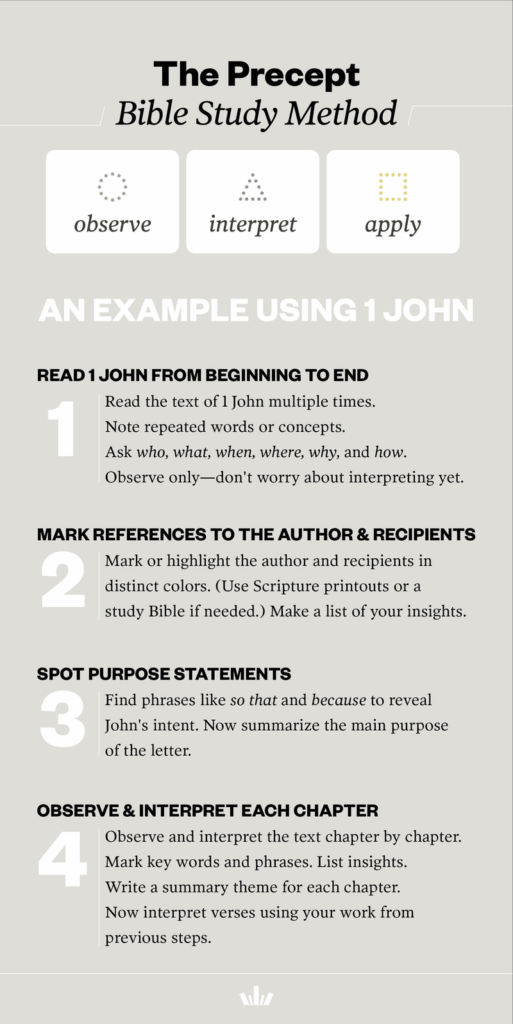
Step 1: Read 1 John front to back
When you’re doing a puzzle, you usually start by getting the “big picture” from the edge pieces.
Once you have the outer edges, it becomes much easier to fill in the middle with the details.
Scripture is not a puzzle, but in a similar way it’s often better to get the big picture of a book of the Bible before you try to make sense of the details.
So start off by reading 1 John from beginning to end—without any breaks if possible, so that you can get the flow of the letter as the original audience would have received it. (Don’t worry; it’s only five chapters!)
Here are some tips regarding this initial step:
- Read and reread the text several times so that you get very familiar with the overall content of the book
- Read out loud when you can—this may feel awkward at first, but you might be amazed at the different details you notice when you say the text of Scripture out loud! (This also forces you to slow down so that you don’t miss as many details.)
- You can also have the text of Scripture read aloud to you via a Bible app or audio Bible while you follow along in your own Bible.
- Another idea is to fill in some of the “background noise” of your days (i.e., when you’re in the car, in the shower, folding laundry) by listening and re-listening through the text.
- As you’re going through the process of reading, rereading, and listening, jot down any repeated words, phrases, or concepts that you notice.
- Start thinking like an investigative journalist, asking the “who, what, when, where, why, and how” of what the author is saying—you can keep in mind (or write down) any questions that come up in your reading.
With this step, you’re not trying to understand everything that you read. You’re just doing the initial work of observing what the text is simply saying.
Without doing the work of simple observation, any conclusions you come to about the text’s meaning (or interpretation) may be inaccurate, and you may not understand how to correctly apply it to your life.
Step 2: Mark every reference to the author and recipients
After you’ve spent several days reading, rereading, and absorbing the text of Scripture, read 1 John again while marking every reference to the author and to the recipients.
We recommend marking them distinctly in different colors.
(If you’re hesitant about marking in your Bible, you can print off the text from a website like biblegateway.com or purchase a Bible specifically for the purpose of marking the text, such as the New Inductive Study Bible.)
The purpose of this step is to help set the context for the book by slowing down and observing everything you can about who wrote it and whom it was written to.
Make a list of any pertinent insights you observe about the author and recipients.
Step 3: Look for 1 John’s “purpose statements”
1 John contains several “purpose statements” throughout.
These are statements that help explain why John wrote the book.
Read through the text carefully and see if you can locate these. (Look for phrases like “so that” or “because” in connection to John’s purposes for his audience.)
Once you’ve located these statements, write down the references and a succinct summary of what you believe to be John’s main purpose in writing the book.
Step 4: Observe and interpret the text chapter by chapter
Now that you’ve done a broad observation of the book as a whole, you can zero in on the details of each chapter one by one.
Here’s how you can do that:
- One chapter at a time, mark key words or phrases in distinctive ways—refer back to the list of important words and phrases you made when you were reading and rereading the text initially (see Step 1 above), as well as any additional words or phrases you notice that are repeated or seem important
- Make lists of helpful insights you learn from marking the key words
- Note and mark any contrasts you see within the text—for example, light vs. darkness
- Note and mark any terms that indicate a conclusion or further explanation—such as “so that” or “because”
- Write down a summary theme for the chapter—this will be the main idea you observe in the chapter in just a few words (no need to be too creative here; it’s actually better if you can stick to the specific words in Scripture for your summary, when possible)
- After you've made a thorough observation of a chapter, go through it verse by verse and try to determine what each verse actually means—make your conclusions about the meaning of each verse based on how it fits in with everything you’ve observed about the purpose and context.
Following a process like this will help draw out the intended meaning that John had when he wrote the original message. It will help make sure your conclusions are based on the text rather than on feelings or preconceived ideas.
All along the way…
As you’re studying 1 John, there are some things you can be doing all along the way:
- The first and most important thing is to pray.(We can never repeat this too much!)
- Think about how everything you’re observing relates to the “purpose summary” you came up with for the overall book, and write down your observations and conclusions. (Hint: when it comes to 1 John, look for the word know.)
- Look up pertinent cross-references to gain a deeper understanding. Cross-references are other passages of Scripture that discuss a similar topic as the passage you’re studying. Many Bibles give you cross-references in the margins of the text, or you can find cross-references by searching for relevant terms in a digital Bible or word study tool.
- Always remember that the point of studying the Bible is not just to accumulate head knowledge. Rather, it’s about knowing your Savior more deeply and allowing that deeper knowledge to change your life. So each day that you study, stop and ponder the truths you’re observing, and pray about how you can apply them to your own life right now. If you have a hard time thinking of a specific application for your life, remember that sometimes an application can be as simple as being moved to a reverent awe and worship of God!
If you want to go deeper…
We don’t want to overwhelm you, and the instructions listed above are enough to keep you very busy!
So if you don’t feel like you can handle much more at this point, don’t sweat it.
But if you’re looking to go even deeper, there’s even more you can do…
- Word studies—word studies allow you to see the actual Greek words that John used (and see where else those specific words are used in Scripture), so that you can get a more accurate meaning of the text. Word study tools such as Blueletterbible.org make doing word studies very easy.
- Bible study guides—the Bible study guides at Precept are designed to help you dig into the text of Scripture for yourself. If you have limited study time, you can check out God’s Love Alive in You which is a survey of 1 John, 2 John, 3 John, James, and Philemon. For a more in-depth study, check out our Precept Upon Precept® study on 1 John, 2 John, and 3 John.
- Commentaries—commentaries can give you additional context and insights that can help you check your conclusions or give further insight into the meaning of the text. However, we recommend that you glean as much insight as you can from the text itself before consulting commentaries. We want Scripture to be the primary interpreter of Scripture, and if you consult commentaries too soon, they may prejudice your approach to the text.
- Know God Deeply podcast—check out our latest season on the Know God Deeply podcast. We’re doing some deep dives into 1 John that’ll help you understand and apply the text to your life as you study it for yourself.
Studying 1 John can change your life!
1 John is a treasure trove of truth from the mouth of God Himself.
And any effort to study what God’s Word says is a worthwhile pursuit.
It may seem daunting at times, but by the power of the Spirit, you can dive in and discover the diamonds that God has left for you.
And when you discover the treasures of God’s Word…
There’s no telling what He’ll do in your life.
We’re diving into 1 John in the latest season of the Know God Deeply podcast! Get a deeper understanding of the treasures of 1 John with David Arthur and friends—check out the podcast today.
1 John Bible study guide FAQ
Who wrote 1 John?
The Apostle John is believed to be the author of the epistle of 1 John.
When was 1 John written?
The exact date of the writing of 1 John is unknown. It may have been between A.D. 85-95 before the Apostle John’s exile to the Isle of Patmos.
Who was 1 John written to?
The audience of 1 John is not specified, but it was clearly a group of believers that the author (presumably the Apostle John) cared about.
How many chapters are in 1 John?
There are five chapters in 1 John.
What is 1 John about?
1 John addresses several topics, such as assurance, love, sin, and false teaching.
Where is 1 John in the Bible?
1 John is toward the end of the New Testament in the group of books known as the General Epistles.
Why was 1 John written?
There are several purpose statements in 1 John. We’d recommend that you find these for yourself as you read it so you can experience the joy of discovery, but if you need help check out these references (spoilers!): 1:4; 2:1, 12-14, 21, 26; 5:13.
Probably the most well-known purpose statement in 1 John is 5:13: “I write these things to you who believe in the name of the Son of God, that you may know that you have eternal life.”
Did the same John write John and 1 John?
Yes, it is believed that the Apostle John wrote the Gospel of John as well as 1 John (also, 2 John, 3 John, and Revelation).
Is 1 John Old or New Testament?
1 John is in the New Testament, toward the end of the Bible as a part of the General Epistles.